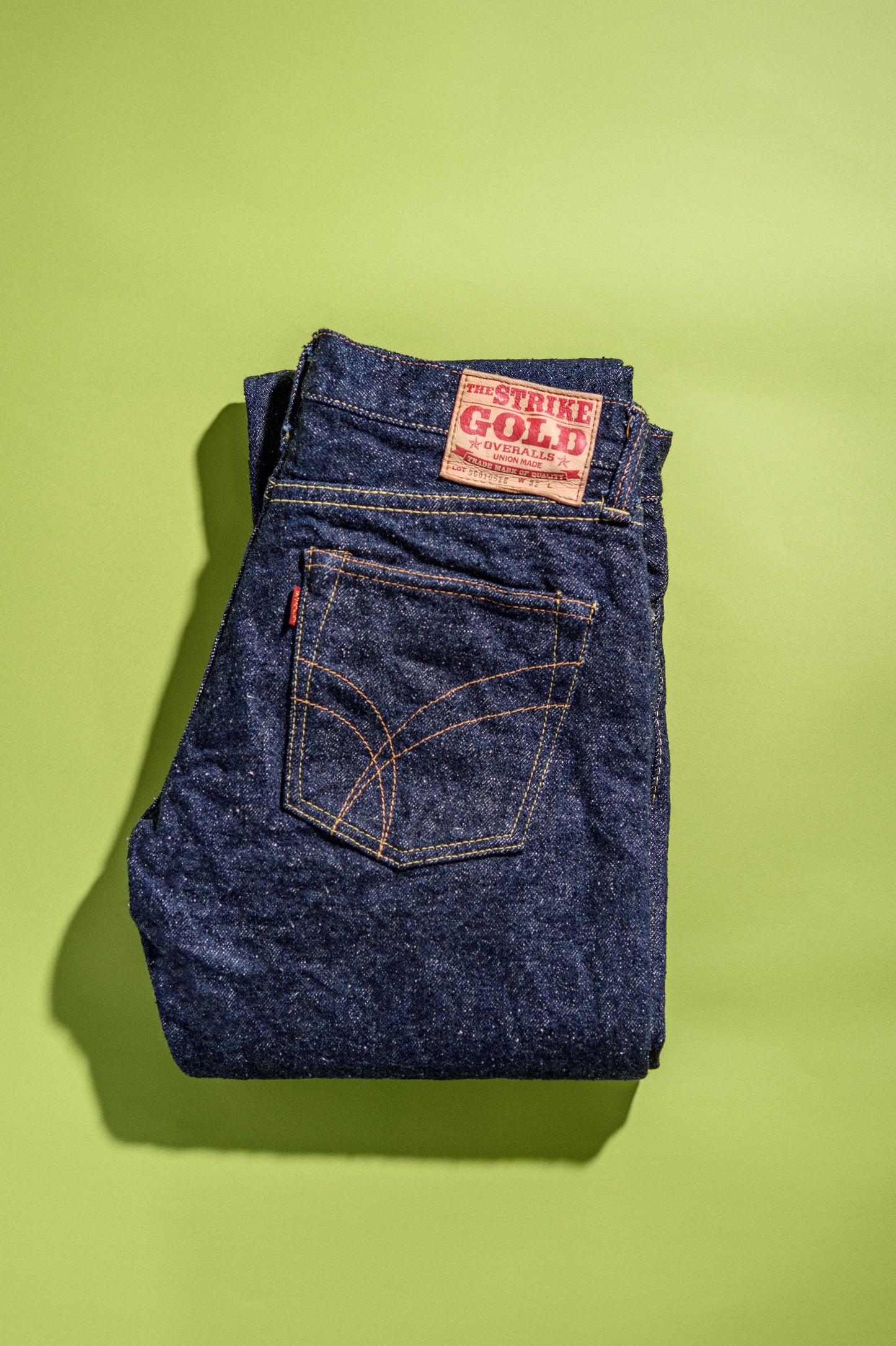
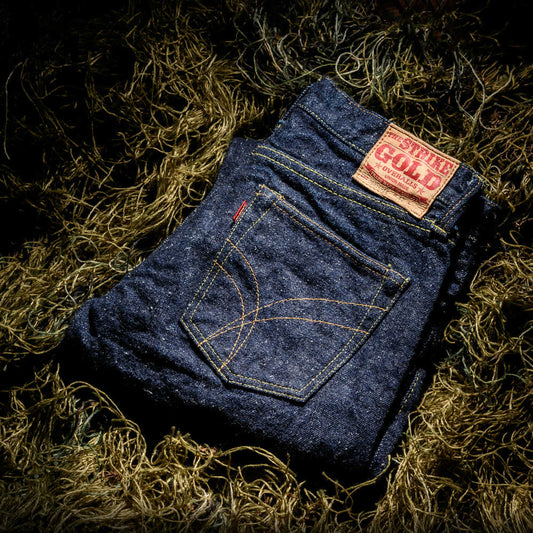
Browse The Strike Gold jeans and you’ll see model numbers like SG5103, SG7105, and SG0109KE. You can tell the numbers differ, but if you’re new to the brand, it may not be obvious what they mean.
There’s a clear rule behind those four digits. The first two digits are the fabric series, and the last two are the fit. Once you can read those two numbers, a model number tells you at a glance what fabric a pair is made from and how it’s cut.
In this guide, we’ll walk through how to read the numbers, one part at a time. We’ll cover the 8 fabric series and the 5 fits, and then show you how to use a model number to find the pair that suits you.
Reading SG Plus Four Digits
| SG | 51 | 03 | (KE / ID) |
|---|---|---|---|
| Brand: The Strike Gold | Fabric series (first two digits): 51 = Classic Series | Fit (last two digits): 03 = Classic Straight | Suffix letters: KE = Keep Earth Series, ID = Classic Series - Double Indigo |
| Example: SG0103KE | 01 = Keep Earth Series | 03 = Classic Straight | KE |
| Example: SG7105 | 71 = Super Slubby Series | 05 = Stylish Straight | None |
| Example: SG5009ID | 50 = Classic Series - Double Indigo | 09 = Slim Tapered Straight | ID |
Core jeans (SG plus four digits) only. T-shirts (SGT), sweats (SGC), shirts (SGS), and jackets (SGJ) use a different system.
The model number on a pair of The Strike Gold core jeans is the brand’s initials, SG, followed by four digits. Those four digits split into two pairs: the first two are the fabric series, and the last two are the fit.
Take SG5103. Here, 51 is the Classic Series fabric and 03 is the Classic Straight fit. So SG5103 means a pair of jeans in the Classic Series fabric, cut in the Classic Straight fit.
That’s the one thing to remember: the first two digits give you the fabric, and the last two give you the fit. Once you know what each number stands for, you can read every model number the same way.
What KE and ID Mean

Some model numbers end in letters, like SG0103KE or SG5004ID.
KE appears on the Keep Earth Series (SG01XXKE), and ID appears on the Classic Series - Double Indigo (SG50XXID). You read these numbers the same way as all the others. The first two digits tell you the fabric series, and the last two tell you the fit, whether or not letters follow.
Other Items Use a Different System

This way of reading model numbers applies to The Strike Gold core jeans, the ones numbered SG plus four digits.
Some other items from The Strike Gold carry letters that show their category, such as SGT for T-shirts, SGC for sweats, SGS for shirts, and SGJ for jackets. Their numbers follow a different rule from the jeans, so this guide covers core jeans only.
The First Two Digits: 8 Fabric Series

The Strike Gold core jeans come in 8 original denim fabrics. The first two digits of a model number tell you which fabric series a pair is made from.
Each fabric uses a different combination of cotton type, spinning method, indigo dyeing, and weave. Those differences show up in how the fabric looks, how it feels to wear, and how it changes as you break it in.
Below, we introduce each fabric series. The Classic Series - Double Indigo (50) is built on the Classic Series (51) fabric, so it follows 51 here instead of appearing in number order. One note on ounces (oz): the figure is a guide to the fabric’s weight. It doesn’t directly tell you how thick or stiff the fabric is, how it will feel to wear, or how it will fade over time.
What Is Oz in Denim, and Why It’s Only Part of the Story
| First two digits | Series | Fabric | Weave | Weight |
|---|---|---|---|---|
| 01 (+KE) | Keep Earth Series | 100% organic cotton, rope-dyed in 100% natural indigo, selvedge | 17 oz | |
| 10 | Origin Series | Low tension, nep blend, selvedge | Right-hand twill | 14 oz |
| 21 | Tough Series | High-density, selvedge | Right-hand twill | 17 oz |
| 31 | Cool Series | High-density, selvedge | Left-hand twill | 17 oz |
| 51 | Classic Series | Gray slub weft, selvedge | Right-hand twill | 15 oz |
| 50 (+ID) | Classic Series - Double Indigo | Indigo double-face slub, selvedge | Right-hand twill | 15 oz |
| 71 | Super Slubby Series | Super slub, selvedge | Right-hand twill | 17 oz |
| 81 | Shower Slubby Series | Shower slub, selvedge | Right-hand twill | 16 oz |
Ounces (oz) are a guide to fabric weight. They don’t directly tell you how thick or stiff the fabric is, how it will feel to wear, or how it will fade over time.
01 (KE): Keep Earth Series

This 17 oz selvedge denim uses yarn made from 100% organic cotton: organic cotton blended with Organic Fallin Cotton, the short fibers left over from spinning, sourced from organic cotton only. The yarn is rope-dyed in 100% natural indigo.
The series started from a focus on making materials with care for the environment, and its model numbers end in KE. As you wear it in, you can enjoy the color that only natural-indigo yarn gives.
10: Origin Series

Based on a study of deadstock denim from the 1940s–1950s, this 14 oz selvedge denim reinterprets the simple, rustic character of that era.
An original blend of nep yarn (yarn with small flecks of fiber) is woven at low tension. The result is a fabric with the firm body of a right-hand twill and a soft hand at the same time. The more you wear it, the more you’ll see three-dimensional, classic vertical fading (tate-ochi).
The Strike Gold Origin Series: Japanese Selvedge Denim
21: Tough Series

A 17 oz selvedge denim woven in a high-density right-hand twill.
Beige weft yarns show faintly on the surface and give the indigo warp a character of its own. The longer you wear it, the more you can enjoy fades with strong contrast between light and dark.
31: Cool Series

A 17 oz selvedge denim woven in a high-density left-hand twill.
Gray weft yarns are packed in as tightly as possible against warp yarns dyed to the deepest shade of indigo, and the cloth is woven in a left-hand twill. The result is a rich deep blue and sharp vertical fading (tate-ochi) built up from the lines of the left-hand twill.
51: Classic Series

A 15 oz right-hand twill selvedge denim with a gray slub weft.
The weft uses gray slub yarn (yarn with thick and thin spots), woven slowly and carefully to create a distinctive uneven texture. Very deep indigo warp yarns and gray weft yarns come together in a rich blue, and as you wear the jeans in, small grid-like vertical fades appear.
50 (ID): Classic Series - Double Indigo

Built on the Classic Series fabric, this 15 oz selvedge denim is an indigo double-face cloth. Its weft is indigo-dyed too: a slub yarn dyed a very deep indigo with a white core.
Because both the warp and the weft are dyed with indigo, it looks and fades differently from the regular Classic Series. Model numbers in this series end in ID.
Classic Series - Double Indigo SG50XXID
71: Super Slubby Series

A 17 oz right-hand twill selvedge denim with a pronounced super slub weft.
The warp yarns are rope-dyed to the deepest shade of indigo and vary greatly in thickness. The weft is a heavily slubbed yarn, full of thick and thin spots. The cloth is woven on vintage shuttle looms at very low tension, as loosely as the looms allow, which gives it a rugged, three-dimensional surface. Together, the yarns and the loose weave create the bold, uneven character that defines this series.
81: Shower Slubby Series

A 16 oz right-hand twill selvedge denim with a shower slub.
The warp yarns are rope-dyed at different depths, so each single yarn carries its own uneven color. The weft is slub yarn, too, woven slowly and patiently at very low tension. The result is fine variation in shade across the whole fabric.
The Strike Gold’s Classic Lineup: Choosing Your Jeans by Denim Fabrics
The Last Two Digits: 5 Fits

| Last two digits | Fit | Features |
|---|---|---|
| 02 | Loose Straight | Roomy through the hips and thighs, with a gentle taper to the hem |
| 03 | Classic Straight | A regular straight that stays clean through the hips, with a gentle taper |
| 04 | Regular Tapered | Roomy through the thighs, with a sharp taper to the hem |
| 05 | Stylish Straight | A tight straight cut, slim from the thigh to the knee, with little taper |
| 09 | Slim Tapered Straight | A slim, cigarette-style straight, tapered all the way down |
The last two digits of a model number tell you the fit.
The Strike Gold core jeans come in 5 fits, and the same number means the same fit, whatever the fabric. For example, 03 is the Classic Straight fit in SG0103KE, in SG5103, and in SG7103 alike.
02: Loose Straight

A relaxed loose straight with room through the hips and thighs.
The overall fit is roomy, but a gentle taper toward the hem helps keep it from looking sloppy and gives it a natural line.
03: Classic Straight

A classic regular straight that stays clean through the hips, without extra bulk.
It has a gentle, natural taper. It’s a fit for a basic vintage style.
04: Regular Tapered

A tapered fit with room through the thighs that narrows sharply toward the hem.
Because there’s room in the thighs, it looks clean without feeling tight, which sets it apart from slim or skinny fits.
05: Stylish Straight

A tight straight cut, slim from the thigh to the knee.
It’s a staple fit: slim but with little taper, so it pairs easily with boots, whether you tuck the jeans into them or wear the jeans over them.
09: Slim Tapered Straight

A slim, cigarette-style straight, tapered all the way down.
The narrow line from the seat to below the knee makes the legs look long and clean. It’s a unisex fit.
The Strike Gold makes every fit and every fabric with how the jeans will age in mind. As you wear them in, the denim softens and molds to your body, and it keeps building its own character from there.
So don’t judge them only by how they feel the first time you put them on. Break them in, make them your own, and enjoy denim that reflects your life and keeps evolving with you for years.
The Strike Gold’s Classic Lineup: Choosing Your Jeans by Fit & Style
Why Fabric and Fit? The Strike Gold’s Approach

The Strike Gold builds its model numbers from two numbers, one for fabric and one for fit, because it makes jeans to be chosen by fabric and by fit.
In the same fit, a different fabric makes a completely different pair: it looks different, feels different to wear, and changes differently as you break it in. The 8 fabrics and 5 fits are there so you can choose for yourself what character you want to grow and what shape you want to wear.
The Strike Gold’s idea of “The Best Ordinary” means jeans aren’t finished by factory treatments. They’re finished by the life of the person who wears them. If 10 people wear the same model number, you get 10 different sets of fades. A model number is simply the mark you use to pick your starting point.
There’s a reason to choose every combination.
The Making of The Strike Gold Jeans
Find Your Pair in 3 Steps

Step 1: Pick the Fabric (First Two Digits)

Start by thinking about what kind of denim you want to wear.
For a simple, vintage-like character, there’s the Origin Series (10). For bold texture and unevenness, look at the Super Slubby Series (71) or the Shower Slubby Series (81). For a deep blue with sharp vertical fading, there’s the Cool Series (31). Each fabric has its own personality. We suggest comparing the fabric pages and the fading gallery as you narrow down the series you like.
Find the Perfect The Strike Gold Denim Fabric for Your Ideal Fades
Step 2: Pick the Fit (Last Two Digits)

Next, choose the fit.
As a guide, pick 02 (Loose Straight) for a relaxed fit and 03 (Classic Straight) for a standard straight. Choose 04 (Regular Tapered) for room in the thighs with a clean hem, 05 (Stylish Straight) for a slim fit that works with boots, and 09 (Slim Tapered Straight) for a slim look all the way down. It helps to picture the pants you wear most and the shoes you want to pair them with.
Step 3: Check the Jeans Chart
Once you’ve chosen a fabric and a fit, just put the first two digits and the last two digits together to get the model number. For example, the Classic Series (51) in the Stylish Straight fit (05) is SG5105.
Not every fabric comes in every fit, though. Each fabric is offered in the fits that bring out its qualities, so check the Jeans Chart to see which combinations exist.
| Fabric \ Fit | 02 Loose Straight | 03 Classic Straight | 04 Regular Tapered | 05 Stylish Straight | 09 Slim Tapered Straight |
|---|---|---|---|---|---|
| 01 Keep Earth Series (KE) | SG0103KE | SG0104KE | SG0105KE | SG0109KE | |
| 10 Origin Series | SG1002 | SG1003 | SG1005 | ||
| 21 Tough Series | SG2103 | SG2105 | SG2109 | ||
| 31 Cool Series | SG3105 | SG3109 | |||
| 51 Classic Series | SG5102 | SG5103 | SG5104 | SG5105 | SG5109 |
| 50 Classic Series - Double Indigo (ID) | SG5004ID | SG5005ID | SG5009ID | ||
| 71 Super Slubby Series | SG7103 | SG7104 | SG7105 | SG7109 | |
| 81 Shower Slubby Series | SG8104 | SG8105 | SG8109 |
FAQ
What Do The Strike Gold Model Numbers Mean?
Of the four digits after SG, the first two show the fabric series and the last two show the fit. For example, SG5103 is the Classic Series fabric (51) in the Classic Straight fit (03). The letters KE at the end mean the Keep Earth Series, and ID means the Classic Series - Double Indigo.
What’s the Difference Between SG5103 and SG5105?
Both use the same Classic Series fabric (51), but the fits differ. The 03 is the Classic Straight, and the 05 is the Stylish Straight, cut tight from the thigh to the knee. The fabric is the same, so you can choose between them by the shape you prefer.
What’s the Difference Between SG5103 and SG7103?
Both come in the same Classic Straight fit (03), but the fabrics differ. The 51 is the Classic Series (15 oz right-hand twill with a gray slub weft), and the 71 is the Super Slubby Series (17 oz right-hand twill with a super slub weft). You choose by the character you want to grow.
What Do KE and ID Mean in a Model Number?
KE stands for the Keep Earth Series (100% natural indigo, organic cotton), and ID stands for the Classic Series - Double Indigo (the weft is dyed with indigo, too). You read these numbers the same way as all the others: the first two digits are the fabric, and the last two are the fit.
Does Every Fabric Series Come in Every Fit?
No. Each series is offered in the combinations that bring out the best in both the fabric and the fit, so the number of fits varies by series. You can check which combinations exist in the Jeans Chart.